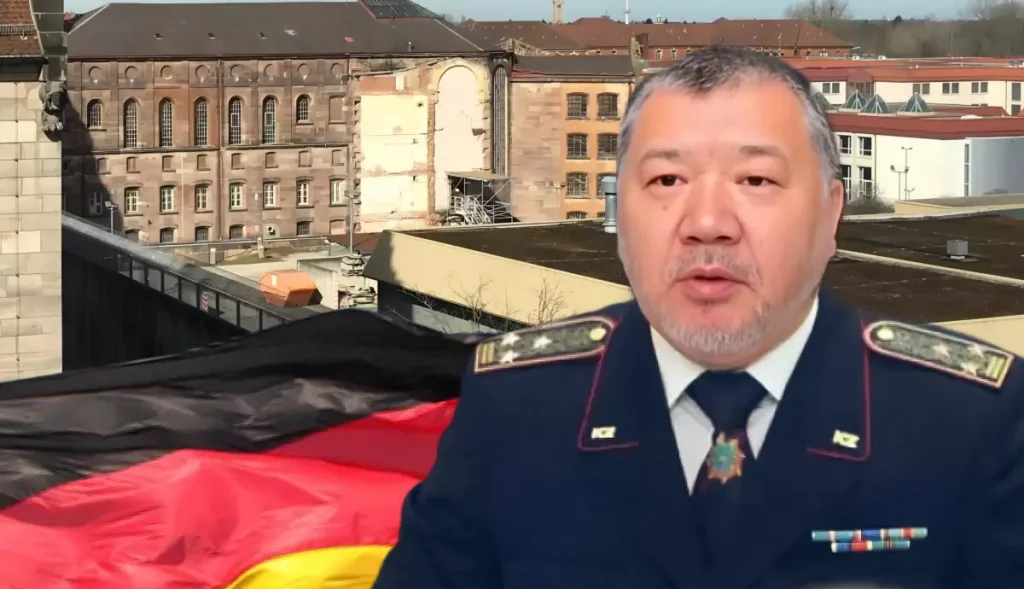
It appears that German judicial authorities are close to extraditing former Transport Prosecutor of the Republic of Kazakhstan Maksat Duisenov to the General Prosecutor’s Office of Kazakhstan. After a month of proceedings, not only did they find no evidence that Duisenov was being politically persecuted in his homeland, but they also began to wonder whether the EU authorities were being too trusting of those who claim to be political refugees. Ulysmedia.kz reports on the details of this case.
Fugitive Maksat Duissenov: What Is the Former Prosecutor and Member of Kozhamzharov’s Team Known For?
From a German prison to one in Kazakhstan
Maksat Duisenov is a figure widely known in certain circles in Kazakhstan. His career is inextricably linked to the ups and downs of Kairat Kozhamzharov. But while Duisenov followed his boss at Finpol and other law enforcement agencies, the criminal case against him in Kazakhstan was opened a month earlier than the one against Kozhamzharov. He was arrested in absentia in Kazakhstan, but Maksat Duisenov ended up in prison in Germany, at the decision of the German authorities. As Deputy Prosecutor General of Kazakhstan, Galymzhan Koigeldiev explained, Kazakhstan initiated the process of extraditing Duisenov. Still, the German authorities needed time to understand the circumstances, as Duisenov himself claimed political persecution in his homeland and requested asylum. At the same time, Duisenov himself continues to insist that his criminal prosecution has political motives and is related to his previous official activities. Judging by all appearances, the circumstances have been established.
Based on the materials of the extradition and migration case, a consolidated position of three key German authorities can be identified — the Higher Regional Court of Nuremberg-Fürth, the Nuremberg Public Prosecutor’s Office and the Federal Office for Migration and Refugees (BAMF): no compelling grounds for refusing extradition have been identified, the formal conditions have been met, and the principle of double criminality has been confirmed. The court also considered the high risk of Maksat Duisenov absconding and therefore remanded him to custody pending a final decision.
In addition, the BAMF, the only authority assessing the issue of political asylum, not only failed to make a final decision, but also, most likely, did not believe the ‘refugees’ story.
Firstly, the former transport prosecutor had never been a dissident and had not been involved in political or social activities. Secondly, before his arrest, he led a life that bore little resemblance to that of a political refugee. Duisenov had not worked officially for many years and had no source of income, yet shortly before applying for asylum, he and his family made numerous expensive trips abroad: Thailand, Turkey, Brazil (Rio de Janeiro, Iguazu), Argentina (Buenos Aires, Perito Moreno), Peru, Brazil again, Russia, Georgia, Uzbekistan, Dubai, Qatar, and Germany.
“The BAMF treats such stories as a classic marker of unreliability (Unglaubwürdigkeit), because a person who is truly fleeing political persecution does not travel around the world on tourist routes. A person who fears arrest or persecution does not pass through dozens of passport controls — but he did. Travelling through 7–10 countries is the behaviour of someone who feels safe, has capital and freedom of movement, not someone who is being “persecuted”,‘ comments Asel Temirova, anti-corruption expert, member of Transparency International Germany and the TI DE project group ’Demokratie und Integrität” (Democracy and Integrity), on Maksat Duisenov’s relationship with the German authorities.
Asel Temirova, anti-corruption expert, member of Transparency International Germany and the TI DE project group ’Demokratie und Integrität”
How is Duisenov damaging the reputation of political refugees?
The expert studied all the documents in the case of the former chief transport prosecutor and concluded that the situation with Maksat Duisenov’s asylum request demonstrates a typical problem: major corrupt officials, taking advantage of changes in the political climate or loopholes in international law, try to avoid responsibility by obtaining asylum abroad. According to Asel Temirova, corrupt officials should not be allowed to become ‘refugees’ by using international protection to evade punishment, especially if they themselves were part of a corrupt system, abused their power and are not political figures. The criminal prosecution of Duisenov is not related to his religious beliefs or political position. All charges are based on specific facts, and the prosecution is exclusively criminal, not political. We are talking about corruption involving tens of millions of dollars. In recent years, a number of former Kazakh officials, including high-ranking security officials, have fled abroad and started supposedly human rights or opposition activities, even though they had a questionable reputation in Kazakhstan.
“If high-level corrupt officials are given the opportunity to abuse the asylum system, this harms not only their countries of origin, but also European democracies themselves, turning the refugee protection system into a tool for evading responsibility. For Germany and the EU as a whole, as well as for Kazakhstan, this is a precedent that requires a delicate approach: denying asylum means trusting the Kazakh justice system, while granting asylum sends a signal of impunity to corrupt officials,” says Asel Temirova.
Since Duisenov is not the first asylum seeker with a dubious reputation, Asel Temirova and her colleagues from Transparency International Germany intend to raise this issue for discussion in the Bundestag, proposing to tighten European asylum policy to prevent further abuse of this institution.
Furthermore, based on Temirova Asel’s analysis, it can be concluded that Kazakhstan’s main claims against Duisenov are still related to the Khorgos case — systemic corruption within a group of individuals, effectively organised as a criminal group.
Episode 1 (September 2009 – April 2011): systematic bribes for smuggling through Khorgos. Every week, $250,000–300,000 in cash collected from smugglers was transferred to Duisenov through an intermediary, Makhatov. During this period, the total amount exceeded $22 million.
Episode 2 (March 2011): extortion of $200,000 from businessman T.T.M.
Episode 3 (spring 2011): Operation Karavanfurer — documented bribes and murder of a witness. As part of the operation, the KNB recorded how Duisenov and Makhatov organised extortion from customs, receiving $202,400. Makhatov was later convicted of murdering a witness in an attempt to cover up the scheme.
Episode 4 (April 2015): bribe with a BMW X6 car
Money laundering
In addition to receiving bribes, Duisenov is charged with legalising (laundering) money obtained by criminal means. Through his brother’s bank accounts, Duisenov cashed out more than 5.5 billion tenge (equivalent to approximately $12–13 million at the average exchange rate for the period). In addition, Maksat Duisenov’s family purchased expensive properties in Astana and Almaty, registered in the names of his wife and brother. These included apartments, a mansion in the Medeu district and land plots, some of which were later re-registered through relatives and front men. Since the German authorities found no grounds for refusing to extradite Maksat Duisenov, except for the risk of torture, the General Prosecutor’s Office of Kazakhstan has the opportunity to show political will and confirm that the country is ready to act according to the principles of legality and transparency. Duisenov really has nothing to fear — not only are the judicial authorities waiting for him, but also the people, who are demanding justice and a purge of corruption.
Independent Review of the Extradition Request from the Federal Republic of Germany Concerning Mr Maxat Duissenov
I.Introduction
This expert opinion has been prepared based on the analysis of official documents issued by the General Prosecutor’s Office of the Republic of Kazakhstan, the case materials of the Nuremberg-Fürth Court, and the records of the extradition proceedings in Germany.
The purpose of this document is to provide an independent professional assessment of the prosecution of Mr Maxat Duissenov, the legal nature of the charges against him, potential misuse of the asylum mechanism, and arguments relevant in light of European standards on human rights and anti-corruption practices.
II. Brief Case Summary
Maxat Duissenov is a former Colonel of the Financial Police of Kazakhstan and a former prosecutor, accused in his home country of serious corruption-related offences. He was arrested in absentia by a Kazakh court and placed on an international wanted list in 2025.
On 22 September 2025, he was detained in Zirndorf, Germany, pursuant to an Interpol notice. Shortly before his arrest, he had submitted an application for asylum. The Republic of Kazakhstan subsequently submitted an official extradition request to Germany (letter from the General Prosecutor’s Office of the Republic of Kazakhstan dated 15 September 2025), accompanied by a full set of case materials.
III. Short Summary of Charges (Duissenov, Makhatov, Zhumabekov)
Episode 1 (September 2009–April 2011): Systematic bribery related to smuggling operations through the Khorgos border crossing. It was established that, weekly, Duissenov received USD 250,000 – 300,000 in cash through an intermediary, Makhatov, who collected the money from smugglers. Between September 2009 and April 2011, the total amount exceeded USD 22 million.
To conceal the corrupt scheme, the Financial Police, headed by Duissenov at that time, formally registered Makhatov as a confidential informant under the alias “Beton”, thereby disguising his actual role in the collection of bribes.
Episode 2 (March 2011): Extortion of USD200,000 for the Removal of Illegally Imposed Obstacles to Carrier T.T. Mirvanov:
In 2011, several freight carriers attempted to avoid paying the imposed corrupt “tribute.” Entrepreneur T.T. Mirvanov established an alternative route for importing goods from China via the Dostyk border crossing, bypassing Khorgos. Upon learning this, Zhumabekov, a subordinate of Duissenov, reported to his superior that Mirvanov’s convoy of seven trucks was en route to Almaty for customs clearance at the Alter warehouse. Duissenov responded with coercive pressure, as before: On 29 March 2011, Zhumabekov sent an official letter to the Almaty Customs Office containing false information about alleged “smuggling” and demanding that T.T. Mirvanov’s trucks be detained. All seven vehicles were illegally stopped and blocked. Zhumabekov personally arrived at the warehouse and prohibited the release of the goods without his authorisation. Finding himself in a critical situation, T.T. Mirvanov contacted the already known intermediary Talgat Makhatov through business acquaintances to “settle the issue.”
The following day, at the restaurant “Tyubeteika,” the price was announced: USD 200,000 for the release of the trucks and the completion of customs clearance. Having no other option, T.T. Mirvanov agreed; the money was handed over to Makhatov through trusted intermediaries. Immediately after the bribe was received, all detained vehicles were released.
Episode 3 (Spring 2011): Operation“Caravan Leader”–Documented Bribery and the Murder of a Witness
Around the same period, Duissenov and Makhatov decided to institutionalise the collection of illicit payments from customs officials. Their target was K.U. Prinbekov, head of the Almaty-West TOO customs post. At Duissenov’s instruction, Makhatov offered K.U. Prinbekov to make monthly payments in exchange for “protection,” otherwise threatening to create problems – up to initiating criminal proceedings against the post’s staff. However, K.U. Prinbekov reported the case to the National Security Committee (NSC/KNB). The KNB opened a covert operation under the codename “Caravan Leader”, within which Prinbekov was engaged as a confidential informant (“Oreke”) and undercover agents were deployed into Duissenov and Makhatov’s circle.
During controlled meetings, Makhatov specified the “tariff”: USD 300 per standard truck and USD 1 500 per truck carrying large shipments – the money was intended for Duissenov. In total, Makhatov and Duissenov received USD 202 400, constituting a particularly large-scale act of bribery.
These covert operations were captured on video and audio, serving as irrefutable evidence. Subsequently, the criminal group resorted to extreme measures to cover their tracks: In 2024, Talgat Makhatov was convicted of murdering M.K. Zhamashev, the intermediary involved in transferring the bribe, in order to eliminate a key witness to the corruption scheme.
Episode 4 (April 2015): Bribe in the Form of a BMW X6
Several years after leaving the Financial Police, Duissenov continued to benefit from his influential connections. In 2015, while serving as an advisor at the Agency of the Republic of Kazakhstan for Civil Service Affairs and Anti-Corruption, he effectively received an expensive gift from his former subordinate, Makhatov. Duissenov instructed Makhatov to purchase a luxury car – a BMW X6 – for his mistress D.K. Akhmetova. On 18 April 2015, Makhatov bought a BMW X6 xDrive35i (2013 model, brown) worth approximately USD 90,000. On 22 April 2015, the vehicle was registered in Akhmetova’s name. This lavish gift is regarded as a bribe in the form of property of significant
value and falls under Article 366, Part 3, Point 3 of the Criminal Code of the Republic of Kazakhstan.
IV. Money Laundering (2016–2023)
In addition to taking bribes, Duissenov is charged with laundering funds obtained through criminal means. The investigation revealed that multi-billion-tenge sums were funnelled through the accounts of his relatives and ultimately accumulated in family assets that could not be justified by their official income.
A.FictitiousTransactions to his Brother’s Accounts.
The following amounts were transferred to the bank accounts of Duissenov’s brother, A.K. Duissenov:
• 474,442,166 tenge (19 July 2016)
• 1,230,392,000 tenge (29 July 2016)
• 120,005,000 tenge (29 July 2016)
• 853,000,000 tenge (18 August 2016)
• 1,920,843,000 tenge (29 September 2016)
• 46,363,776 tenge (21 November 2023)
• 13,892,700 tenge (27 November 2023)
All of these funds were subsequently withdrawn in cash. The total amount exceeded 5.5 billion tenge, equivalent to approximately USD 12–13 million at the average exchange rate during the relevant period.
B. Luxury Real Estate Registered to Relatives
Despite the absence of any official income, Duissenov’s family acquired a number of high-value real estate properties in Kazakhstan.
On 20 April 2018, through his brother A.K. Duissenov, an apartment in Astana (14V Alikhan Bokeikhan Street, apt. 9) was purchased for 149 million tenge, along with two parking spaces (each worth 6.54 million tenge). In 2020, this property was re-registered in the name of G.B. Zharkynbayeva, the wife of M.K. Duissenov.
Previously, on 18 July 2014, G.B. Zharkynbayeva had purchased an apartment in Astana (45/1 Abay Avenue, apt. 69) for 64.5 million tenge and a parking space for 3 million tenge.
In 2019, G.B. Zharkynbayeva, the wife of M.K. Duissenov, also received, as a gift, an apartment in Almaty (97 Dostyk Avenue, apt. 15, with garage), which had previously been registered under the name of third stakeholders.
In Almaty, A.K. Duissenov became the owner of a land plot and mansion located in the elite Medeu district, valued at approximately 392 million tenge. The house was built between 2012 and 2016. Additionally, a large apartment (173.9 m²) in a residential complex on Khozhanov Street 81, with an estimated value of 183.6 million tenge, was registered in his name as a gift in 2019.
Further investigations revealed property and share transfers to other relatives – including his sister Sh.K. Duissenova, Z.A. Kerimbayeva/Keribay, T.A. Kerimbayeva, and others – without compensation. This indicates the creation of a chain of nominee owners aimed at concealing the true ownership of assets.
V. Position of the German Authorities(Court, Prosecutor’s Office, BAMF)
Based on the materials of the extradition and migration proceedings, a consolidated position of three key German institutions can be identified: the Higher Regional Court of Nuremberg-Fürth, the Nuremberg Prosecutor’s Office, and the Federal Office for Migration and Refugees (BAMF).
• No mandatory grounds for refusal of extradition were identified.
• The formal requirements for extradition have been met.
• The principle of double criminality applies.
• A high risk of flight was recognised; therefore, release was ruled out.
• The issue of a possible political nature of the prosecution remains under assessment. (since Duissenov claimed that he is being persecuted forpolitical reasons)
VI.On Political Persecution, Risk of Torture, Fair Trial Guarantees, and theAsylum
The case of Maksat Duissenov illustrates a broader pattern: many high-level corruption figures, taking advantage of political changes or gaps in international law, attempt to evade accountability by seeking asylum abroad. In recent years, several former Kazakh officials, including senior law enforcement officers, have fled the country under threat of criminal prosecution.
The case of Maksat Duissenov illustrates a typical problem: many high-ranking corruption figures, invoking political change or gaps in international law, attempt to evade criminal liability by seeking asylum abroad. In recent years, former Kazakh officials, including senior law enforcement officers, have fled abroad to avoid prosecution, such as Kairat Kozhamzharov, Baurzhan Baibek, Mukhtar Ablyazov, Viktor Khrapunov, and others. European states, as well as Russia and Belarus, have at times granted protection even to individuals with questionable reputations.
After a comprehensive review of all available documents and meetings with whistleblowers, it can be stated with confidence that this case is not political in nature. The prosecution is not linked to Duissenov’s beliefs or political activity. The charges are based on specific factual evidence, and the proceedings are purely criminal, not political. This case concerns systemic corruption involving tens of millions of U.S. dollars, conducted over several years, with the participation of family members, intermediaries, and fictitious transactions used for money laundering.
The argument that Duissenov might be at risk of torture represents a typical defence tactic of corruption suspects, but there is no evidence whatsoever to support such a claim in this case. Duissenov has never been an opposition figure or dissident; he is prosecuted not for his political opinions, but for large-scale corruption. There are no legitimate concerns regarding the transparency of judicial proceedings in Kazakhstan. Such cases can be held publicly and open to media and civil oversight, as demonstrated, for instance, in the Saltanat Nukenova murder case. The court hearing against Duissenov could be conducted publicly, with international monitoring, regular reporting, and independent complaint mechanisms available.
As an anti-corruption expert and member of Transparency International Germany, I firmly believe that a corruption suspect cannot qualify as a refugee and should not be allowed to exploit international protection as a means to escape justice– especially when he himself was part of the power structure and abused his position. Corruption undermines state institutions as severely as political repression or tyranny.
In Duissenov’s case, the issue is not mere personal enrichment, but systemic abuse of power that has caused direct and indirect harm to millions of citizens of Kazakhstan – through the loss of public revenue, erosion of institutional trust, and distortion of justice.
Allowing corruption figures to misuse the asylum mechanism harms not only their countries of origin but also European democracies themselves, as it turns the asylum system into a tool of impunity.
For Germany, the European Union, and Kazakhstan, this case represents a precedent requiring a careful and balanced approach: Refusing asylum means placing trust in Kazakhstan’s justice system, whereas granting asylum would send a message of impunity to corrupt officials.
VII. The economic aspect must also be taken into account.
According to estimates cited in several analytical reports and publications from various German federal states, the cost of holding one person in pre-trial detention (U‑Haft) in Germany is approximately €150 – €200 per day. Duissenov has been in pre-trial detention since September 2025 and is expected to remain in custody until the end of December 2025. These expenses are fully borne by the public budget of the State of Bavaria, representing an additional financial burden on German taxpayers, particularly in the case of an individual accused of large-scale corruption. This further reinforces the need for a prompt and well-reasoned decision on extradition.
Conclusion
Based on the analysis of official case materials, court documents, and relevant EU human rights standards, the following conclusions can be drawn:
1. The prosecution of Maksat Duissenov is purely criminal in nature.
2. The case materials provide detailed confirmation of the corruption charges.
3. No evidence of political motivation has been established.
4. There is no substantiated individual risk of torture.
5. The asylum application is likely being used as a means to evade criminal liability.
***
Based on the analysis of the Duissenov case presented above, it appears necessary to place several systemic issues on the anti-corruption policy agenda and to raise them for political consideration, both within Transparency International Germany and in the Committee on Internal Affairs as well as the Committee on Human Rights and Humanitarian Aid of the German Bundestag.
A. What mechanisms can be implemented to protect the asylum system from abuse by individuals involved in corruption and economic crimes?
B. How can the balance between protecting human rights and avoiding impunity for persons who have committed corruption offences be ensured?
C. Is there a need to strengthen the training and qualifications of BAMF staff to distinguish more precisely between genuine political persecution and attempts to conceal corruption offences?
D. Would it be appropriate to establish an independent expert group (including representatives of Transparency International) to analyse cases of possible misuse of the asylum system?
E. Should Germany revise the criteria for granting asylum to individuals accused of serious corruption offences—without a political context of persecution—who nonetheless claim political motivation?
Expert Opinion: Independent Review of the Extradition Request Concerning Mr Maxat Duissenov from the Federal Republic of Germany
Prepared by Assel Temirova
Anti-Corruption Expert, Member of Transparency International Germany and the TI DE Project Group “Democracy and Integrity”.
(This opinion represents the author’s independent professional assessment and does not reflect the official position of Transparency International.)
Kazakhstan: Anti-corruption Sanctions Motion made, and Question proposed, That this House do now adjourn.—(Scott Mann.) 17:02:00 Dame Margaret Hodge (Barking)…
A Eurasianet commentary The Paradise Papers comprise millions of leaked documents relating to offshore activities of the super-rich, including Queen Elizabeth…
Hotelier’s transactions via Cork highlight how oligarchs funnel millions through Irish companies to Russia Three Cork-based companies were used by…
Kazakh Opposition sent to UK Authorities the summary of research into London Secret Properties controlled by Dariga Nazarbayeva, Dictator Nursultan…
With a turf war raging in Astana as president Nursultan Nazarbayev’s health declines, Kazakh oligarch Bulat Utemuratov reluctantly finds himself…